An Introduction to Three-Dimensional, Rigid Body Dynamics
Below are links to a set of PDF files which together are an introduction to three-dimensional, rigid body dynamics. Currently, the files are separated into three volumes. Volumes I and II are an introduction to three-dimensional rigid body kinematics and dynamics. One unit in each of these volumes is an introduction to modeling in MATLAB/Simulink/SimScape Multibody®. A third volume is currently being written to provide an introduction to multibody kinematics.
The PDF files can be opened and read in any PDF viewer/reader application. In my experience, some of the viewers work better than others, so you may want to try different viewers to optimize your experience.
Trademarks: MATLAB, Simulink, and Simscape Multibody are all registered trademarks of The MathWorks, Inc. The MathWorks does not warrant the accuracy of the examples given in these notes.
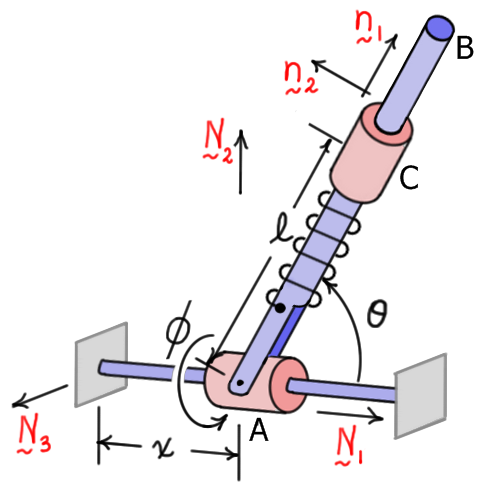
Volume I: Kinematics
Summary of Volume I Contents
- Unit 1 – Angular Velocity and Angular Acceleration – An Introduction
- Unit 2 – Velocity and Acceleration using Direct Differentiation
- Unit 3 – Relative Kinematics of Two Points Fixed on a Rigid Body
- Unit 4 – Kinematics of a Point Moving on a Rigid Body
- Unit 5 – Rigid Body Orientation, Orientation Angles, and Angular Velocity
- Unit 6 – Rigid Body Orientation, Orientation Parameters, and Angular Velocity
- Unit 7 – Application of Concepts to Systems with Complex Interconnecting Joints
- Unit 8 – Introduction to Systems with Closed Kinematic Chains
- Unit 9 – Introduction to Systems with Rolling Constraints
- Unit 10 – Introduction to Modeling Mechanical System Kinematics Using MATLAB/Simulink/Simscape Multibody
- Three-Dimensional Slider Crank Mechanism Movie:
Volume II: Kinetics
Summary of Volume II Contents
- Unit 1 – Inertia Matrices, Angular Momentum, and Kinetic Energy
- Unit 2 – Newton/Euler Equations of Motion
- Unit 3 – Degrees of Freedom, Partial Velocities and Generalized Forces
- Unit 4 – Principle of Virtual Work and Lagrange’s Equations
- Unit 5 – d’Alembert’s Principle and Kane’s Equations
- Unit 6 – Lagrange’s Equations, d’Alembert’s Principle, and Kane’s Equations for Constrained Systems
- Unit 7 – Introduction to Modeling Mechanical System Kinetics Using MATLAB/Simulink/Simscape Multibody
- Unit 8 – Basic Concepts of Linearization, Stability, Mode Shapes, and Natural Frequencies
YouTube – Veritasium – The Bizarre Behavior of Rotating Bodies
 Dynamics, Motion, and Control